Thread Choices for Patch Color
Thread comes in a fixed range of dyed colors. Understanding that one fact explains most of what happens between your brand guidelines and the finished patch.
AT A GLANCE: KEY TAKEAWAYS
- Thread is dyed to a fixed range. That single fact explains why no supplier can promise an exact brand match.
- Send a color reference rather than a screenshot. A number from your brand guidelines is worth more than an image.
- Color adjacency matters more than color count. Two similar shades meeting on a small element read as one from a distance.
- The proof is where color gets decided, and it is worth looking at on more than one screen.
- Nobody can promise colorfastness in the abstract. It depends on the garment and how it is cleaned.
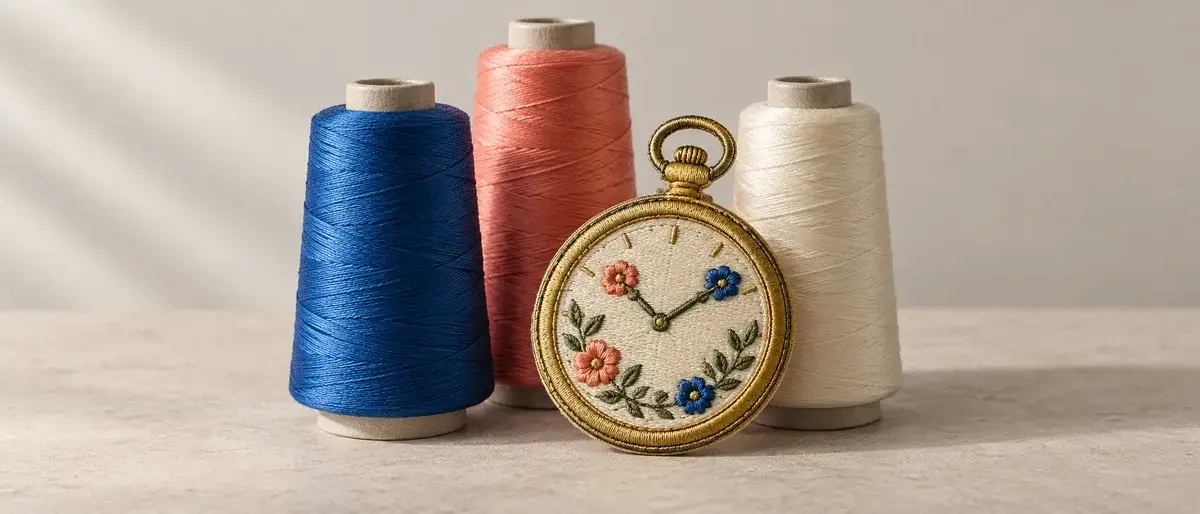
Everything on this page follows from one physical fact: embroidery thread is manufactured in a fixed range of dyed colors. It is not mixed to order the way ink is. A supplier picks the closest available thread to your reference, and how close that is depends on where your color happens to fall relative to what exists.
That is why an honest answer to "can you match our brand blue" is always a version of "we will get close and show you". Anyone promising an exact match is describing a process that does not exist.
What to send, and why it matters
A color reference beats an image every time. If your brand guidelines specify a color as a standard reference number, send that number. It describes the color unambiguously, and a supplier can compare it against a physical thread range.
A screenshot describes your monitor, not your color. Two people looking at the same file on different screens are looking at different colors, and neither of them is looking at thread. Sending a JPEG and asking for the blue in it means someone is guessing at a value from a rendered image.
If you only have artwork, say so. It is a perfectly normal situation and it is workable. It just means the color decision moves to the proof stage, where you are approving a specific thread rather than a value.
Color count is not the interesting question
People ask how many thread colors a patch can have far more often than they ask the question that actually affects the result, which is how the colors sit next to each other.
Thread has physical width. When two similar shades meet along an edge, the boundary between them is a row of stitches, and at any distance those two colors read as one slightly muddled area. A design with nine carefully chosen related shades can look like four colors from across a room, which is usually not what the designer intended.
The practical implications:
- Adjacent colors want contrast. If two elements need to read as separate, give them tonal separation rather than only hue separation.
- Small elements want more contrast than large ones. A large field can carry a subtle color relationship. A three-millimeter detail cannot.
- Outlines do real work. A dark outline between two similar colors solves the adjacency problem better than changing either color does.
Where color goes wrong on a subdued version
Any organization that orders both a full-color and a low-contrast version of the same design runs into this. Subdued palettes work by removing contrast, which is the point, and removing contrast is also what makes detail disappear.
A design that reads clearly in full color can lose its smallest elements entirely once the palette is compressed. The fix is to adjust the artwork for the reduced palette rather than recoloring the same file and hoping. That means deciding which elements have to survive and giving them the separation to do it, sometimes at the cost of elements that mattered less.
Plan both versions from one piece of artwork at the same time. Making the second one months later means matching against a finished patch rather than against the source file.
The base fabric is part of the palette
On an embroidered patch, wherever the thread does not fully cover the twill, the twill shows. That is not a defect, it is a design decision called coverage, and the base color is part of the finished appearance.
Full coverage hides the base entirely and uses more thread. Partial coverage leaves twill visible as a deliberate element, weighs less and costs less to make. If you are choosing partial coverage, choose the base color with the same care as the thread colors, because it is one of them.
What nobody can tell you in advance
Colorfastness. How well a color holds up depends on the thread, the garment, the laundering process, the chemicals and how much sun the item sees. General claims about thread durability are not worth much, and we do not publish test results we have not run. If you have a specific requirement, describe the actual conditions and get an answer for that case.
How it will look in your lighting. Thread has direction, and direction is what makes embroidery catch light. The same patch reads differently under a shop light, on a stage and outdoors. A proof cannot fully capture that.
Whether the screen is lying. It is, slightly, always. This is why the physical sample included with a confirmed order matters more than people expect: it is the first time anyone sees the actual colors on the actual construction.
A short checklist before you approve a proof
- Compare the proof against your color reference, not against your memory of it.
- Look at it on more than one screen if the colors are important.
- Check the smallest colored element specifically, since that is where adjacency problems show first.
- If a subdued version is coming, look at both together.
- If the color has to be right rather than close, say so before approval rather than after production.
Frequently Asked Questions
Can you match my exact brand color in thread?
How many thread colors can an embroidered patch have?
What should I send for color?
Will the colors fade?
Why does my subdued version look flat?
Latest Articles
View All Articles
How Embroidered Patches Are Made
Six stages between a logo and a finished patch. Most of the decisions that determine how it looks are made before a single stitch goes down.
READ MORE
PVC, Silicone and Rubber Terms
Three words, two materials, and a lot of confusion. What people mean when they say rubber patch, and why the distinction matters once you are ordering.
READ MORE
How to Design a Custom Patch
Most patch designs go wrong in the same order. Here is the sequence that avoids it, starting with the one decision everything else depends on.
READ MORE