Woven vs Embroidered Patches
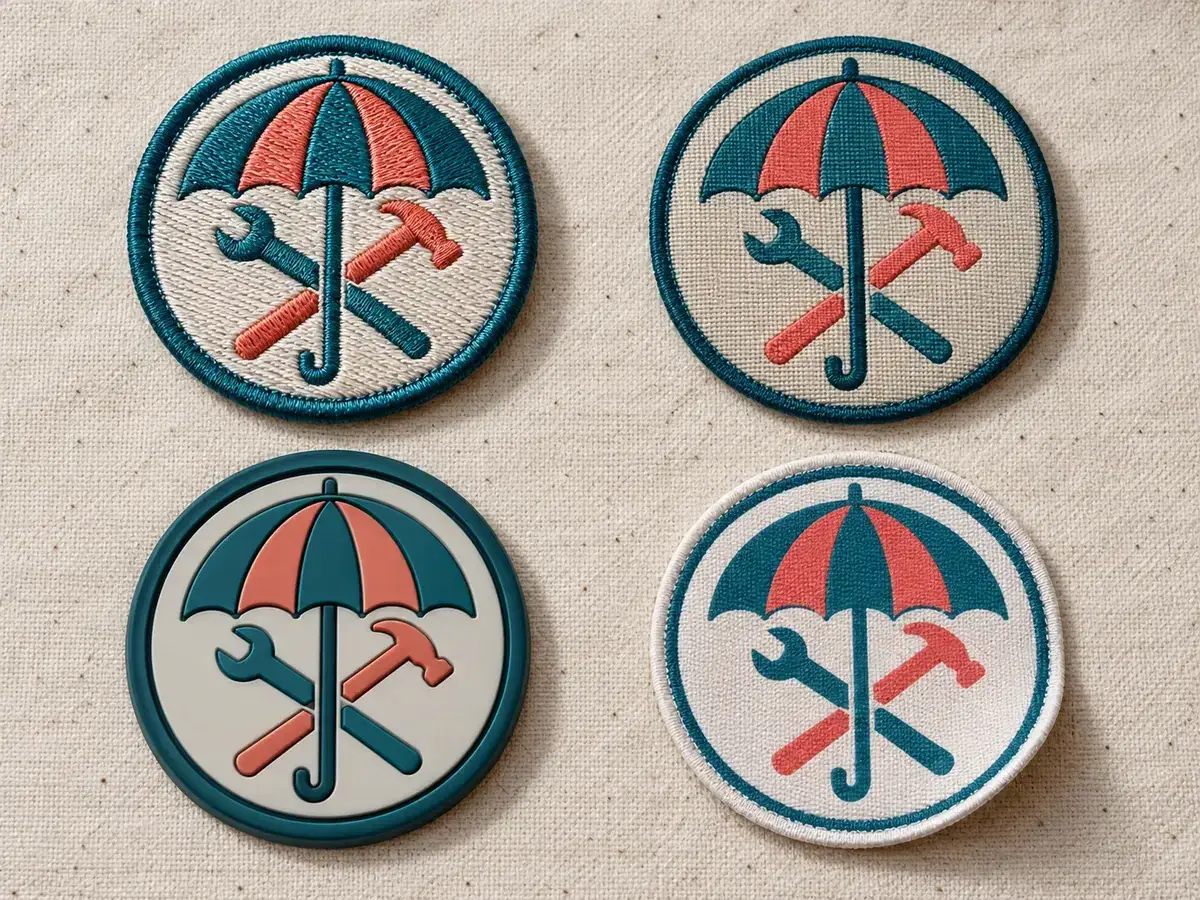
Both are thread. One holds small lettering, the other holds texture. The smallest element in your artwork decides between them more reliably than taste does.
AT A GLANCE: KEY TAKEAWAYS
- Woven uses much finer threads on a loom. Embroidery uses thicker thread stitched onto twill.
- The smallest element in your artwork settles this more reliably than any preference.
- Woven holds text down to around 2 mm where the letterform allows. Embroidery closes up fine type sooner.
- Embroidery gives visible texture and slight relief. Woven is flat and smooth.
- Woven is capped at 12 colors and has no gradients. Embroidery's color count follows the artwork.
Both are made of thread, and that is where the similarity ends. They are made on different machines, they hold different amounts of detail, they feel different in the hand and they suit different designs.
The good news is that the decision is usually settled by a single question about your artwork, not by preference.
The physical difference
Embroidery is thicker thread stitched onto a twill base. The stitches sit on top of the base fabric, which is why an embroidered patch has visible texture and a slight raise you can feel. Coverage is a design decision: the thread can cover the twill entirely or leave it showing as part of the design.
Weaving makes the design as the fabric is made rather than applying it to a base. The threads are much finer and they run flat, so the finished patch is thinner and smoother, with no relief.
That single structural difference produces every other difference below.
Detail: woven wins, and it is not close
Because the threads are finer, woven holds lettering down to around 2 mm where the letterform allows. Embroidery reaches its limit noticeably sooner, because a stitch cannot be thinner than the thread making it, so fine serifs, thin strokes and tight counters fill in.
The elements that force this decision:
- A tagline or a wordmark under a symbol
- A founding year, usually in the least forgiving part of a layout
- A city or jurisdiction line inside a seal
- A motto around a rim, where curved letters get narrower as the curve tightens
- A long surname on a fixed-length tape
If your design has any of these and the finished size is modest, woven is probably the answer regardless of what you would have preferred.
Texture: embroidery wins, and that is also not close
Run a finger across an embroidered patch and you feel stitching. Run it across a woven one and you feel smooth fabric.
For a lot of buyers this is the whole decision. A traditional patch look, thread you can see catching light, a slight three-dimensionality: none of that is available in woven, and no amount of design work produces it.
Thickness and how it sits
Woven is flatter and thinner, which has practical consequences beyond appearance:
- It sits closer to the garment, which suits shirts and lightweight fabric where a thick badge feels heavy.
- Less of the patch stands proud to catch and abrade in a wash cycle. That is a structural advantage rather than a laundry certification, and we do not present it as one.
- It works better under a seam or in a tight placement.
Embroidery's extra thickness is not a defect. On a jacket, a vest or a heavy garment it reads as substantial rather than bulky.
Color
Woven is capped at 12 colors, and because each color is a discrete thread there are no gradients or shading. What matters more than the count is adjacency: two similar shades meeting on a small element read as one color from any distance.
Embroidery's color count follows the artwork and is confirmed on the proof. It has the same adjacency issue, more so, because the thread is thicker.
Neither reproduces a photograph or a gradient. If your design depends on tone, both are the wrong answer and printing is the right one.
Edge
Both take the same border options and the outline decides which is possible.
Merrow wraps a rounded thread edge around the patch, and it suits simple shapes such as circles, ovals, shields and rectangles because the machine travels a continuous path.
Laser or hot-cut cuts the patch to shape and seals the edge, so it follows tight curves, thin points and die-cut logo shapes, and it sits flatter.
One practical note: a flat woven patch with a hot-cut edge is about as thin and unobtrusive as a patch gets, which is why that combination shows up on shirts and under seams.
Cost
There is no simple answer, and anyone giving you one is guessing. Price moves with quantity, finished size, coverage, complexity, backing and deadline rather than with the construction name alone.
What is true: a small simple embroidered patch and a small simple woven patch land close together. The gap opens up as designs get larger and more heavily covered, because coverage is real production work in embroidery and does not have an exact equivalent in weaving.
Ask for the same design quoted both ways. That tells you what the difference actually is on your job, which is more useful than a general rule.
The one question
If you take one thing from this: find the smallest element in your artwork that has to stay readable, and check it at your finished size.
If it survives comfortably in embroidery, you can choose on texture and preference. If it does not, woven is the answer, and no amount of wanting the stitched look changes that. The third option, if neither holds it, is a larger patch.
Who should choose which
Choose woven if: the design has small type, a wordmark, a date or a motto; the patch is going on a shirt or lightweight fabric; the placement is tight; or you need the thinnest, flattest result.
Choose embroidery if: the design is bold with weight in the shapes; you want visible thread texture; the patch is going on a jacket, vest or heavy garment; or the traditional patch look is part of the point.
Choose neither if: the design depends on gradients, shading or a photograph. That is a printed patch, and trying to force it into thread produces a compromise nobody is happy with.
Consider both: some orders run a woven version for the small-type piece and an embroidered version for the main badge. That is a perfectly sensible answer to a design that pulls in two directions.
Frequently Asked Questions
Which holds smaller text, woven or embroidered?
Is woven thinner than embroidered?
Which is cheaper?
Can woven patches have gradients?
How do I decide between them?
Can I order the same design in both?
Latest Articles
View All Articles
How Embroidered Patches Are Made
Six stages between a logo and a finished patch. Most of the decisions that determine how it looks are made before a single stitch goes down.
READ MORE
PVC, Silicone and Rubber Terms
Three words, two materials, and a lot of confusion. What people mean when they say rubber patch, and why the distinction matters once you are ordering.
READ MORE
How to Design a Custom Patch
Most patch designs go wrong in the same order. Here is the sequence that avoids it, starting with the one decision everything else depends on.
READ MORE