Choosing the Right Patch Backing
Eight ways to attach a patch, and the four questions that narrow them to one. The garment decides more than the patch does.
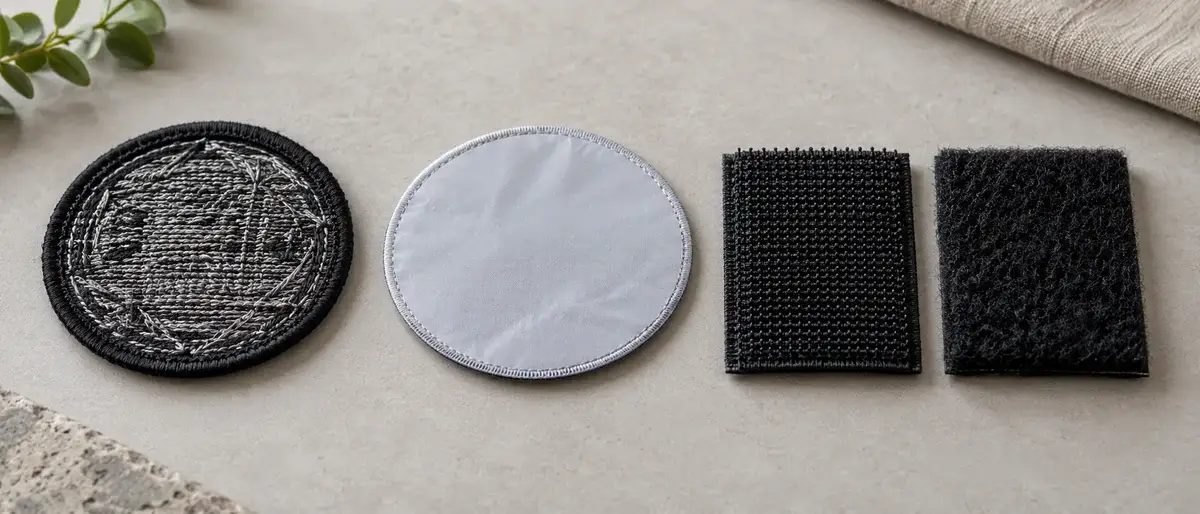
AT A GLANCE: KEY TAKEAWAYS
- The garment decides the backing more often than the patch does. Start there.
- Four questions narrow eight options to one: can it take heat, does it need to come off, will it be washed, and can the garment be modified?
- Iron-on and sewing are not rivals. Pressing to place and then stitching the edge outlasts either on its own.
- Hook-and-loop needs a loop field on the garment, which is a separate item rather than something included.
- Nothing here is a certification. Real performance depends on your garment and how it is laundered.
Eight backings, and most people pick one because it is the one they have heard of. That is usually fine and occasionally expensive, because the wrong attachment on the right patch produces a garment with a hole in it, a lifted edge, or a badge that will not come off when it needs to.
The useful thing to know is that the decision is mostly not about the patch. It is about the garment underneath it and what has to happen to the two of them over the next few years.
Four questions that do most of the work
Work through these in order and you will usually be down to one or two options before you have thought about the patch at all.
Can the fabric take heat? Cotton and cotton blends can. Waterproof and coated shells, leather, heat-sensitive synthetics and heavily textured knits cannot, and pressing them damages the garment before it fixes the patch. This single question eliminates heat-activated backing for a large share of orders.
Does the patch need to come off? Insignia that changes with a role, a season or a shift has to be removable. A club patch or a company badge does not. Getting this wrong in either direction is annoying: a permanent patch on a garment that gets reassigned, or a removable one on something that must never be lost.
Will the garment be washed? Not whether it can be washed, but whether it actually will be, and how. A uniform shirt laundered twice a week is a different problem from a jacket cleaned twice a year.
Can the garment be modified? Some backings need something added to the garment first. Hook-and-loop needs a loop field sewn on. If the garment belongs to the wearer, is rented, or is tailored and expensive, that may not be available to you.
The eight options
Sewing
The most durable attachment and the one with the fewest fabric restrictions. Stitching does not care about coatings, texture or heat sensitivity, which is why leather, waterproof shells and anything worn hard end up here. What it needs is access to both sides of the fabric, which is straightforward on a flat jacket panel and awkward on a lined garment or a finished cap.
Hand sewing suits one garment and gives complete control of placement. A machine suits a run and holds a straighter line. Neither is fast.
Choose it when: the patch is permanent, the garment cannot take heat, or the item is worn hard.
Iron-on, or heat-activated backing
A film on the back of the patch melts into the fabric under heat and pressure. It is fast, needs no skill and no equipment beyond an iron and a firm surface, and it holds the patch flat while you work.
It is also not permanent, and we do not describe it as such. Edges lift over time with wear and washing. Application settings come with the patch, because the right time, temperature and pressure follow the construction and the fabric together rather than a single published recipe. After application, wait 48 hours before the first wash, then wash cold and gentle, inside out where suitable, and air dry or tumble low.
Choose it when: the fabric is cotton or a cotton blend, and speed or ease of application matters.
The combination worth knowing: press the patch to hold it exactly in place, then stitch the edge. That outlasts either method used alone, and it removes the hardest part of sewing a patch on straight. For anything in constant use, this is the answer rather than a compromise.
Hook-and-loop
Made for identifiers that change. The patch carries the hook side and grips a loop field on the garment or gear. Unit insignia, rank, name strips and morale patches all live here because the wearer swaps them in seconds.
The part people miss is that it is a two-sided system. A hook-backed patch does nothing on a garment with no loop field, and the mating loop side is a separate item rather than something included by default. Where a loop field already exists, its dimensions set the finished size of your patch rather than a number you picked.
The trade is that removable means removable: the patch can be knocked off, and the hook face collects lint over time, which gradually weakens the grip.
Choose it when: the identifier changes, and the garment or gear either has a loop field or can have one added.
Adhesive
A pressure-sensitive layer, peeled and pressed by hand with no heat and no tools. It is the fastest attachment and the least permanent, which is exactly right for events and trade shows.
It is not the same thing as iron-on, and the two get confused constantly. Iron-on melts into the fibers of a fabric. Adhesive sticks to the outside of a surface and stays on the surface. That is why adhesive works on plastic, metal, glass and painted panels where heat does nothing, and why it will not survive a wash cycle where iron-on will.
Surface preparation decides most of the outcome, and some surfaces keep residue when the patch comes off. Test an inconspicuous spot on anything you care about.
Choose it when: the use is temporary, or the surface is not fabric at all.
Magnets
One magnet behind the patch, a second inside the garment, gripping through the cloth. Nothing is pierced, stitched or pressed, which makes this the answer for tailored jackets, fine fabric and clothing staff own themselves.
Two things decide whether it holds: fabric thickness and patch weight. A thin shirt with a small badge is a strong pairing; a heavy coat with a large patch is not. There is no universal weight limit worth publishing, because it depends on the garment.
One caution stated plainly: magnets can affect cards, devices and equipment kept nearby, and they are not suitable for everyone. If there is any question about a medical device, choose a different backing. That is not something a patch supplier can advise on.
Choose it when: the garment must not be marked, and the patch is small and light.
Pin fittings
The pin passes through the fabric, so it leaves a small hole and it comes off in seconds. On a work shirt, a bag, a hoodie or a lanyard that does not matter at all. On tailoring, wool or silk it shows permanently.
Pins grip regardless of fabric thickness and hold heavier patches than magnets do, which is the trade for the hole.
Choose it when: the garment is durable, the patch is worn occasionally, or the item is not a garment at all.
Button loops
A fabric loop that slips over a button the garment already has. Nothing is stitched, pierced or glued: the patch hangs. Scouting programs and event passes use it because temporary insignia goes on and comes off without altering the shirt.
The garment decides whether it works, since the loop has to fit over a button positioned where you want the patch. A hanging patch also moves, can be pulled and can catch. We make no child-safety claim about it, and an adult should judge whether it suits the wearer and the activity.
Choose it when: the insignia is temporary and the garment must not be marked at all.
No backing
A finished, edged patch with nothing applied to the reverse. Manufacturers sewing patches into a seam, resellers who apply their own attachment, and makers who stitch everything by hand all order this deliberately.
Worth knowing: the reverse is not a designed surface, and what it looks like depends entirely on the construction. If it will be visible in your finished product, ask before you order.
Choose it when: you have your own application process, or the patch is a component in something else.
What none of this covers
Real performance depends on your garment, your artwork and how the item is actually cleaned. Nothing here is a certification, and we do not publish blanket laundry claims, because the process, the chemicals and the fabric all change the answer. If you have a specific requirement, the useful move is to describe the garment and let a supplier answer for that case rather than relying on a general guide.
The other thing a guide cannot do is settle a decision that has two right answers. Plenty of programs run more than one backing on the same garment: a sewn company badge that never changes, and a hook-backed name strip that does. That is not indecision, it is the correct answer to two different questions.
Frequently Asked Questions
Which patch backing is most permanent?
Can I put any backing on any patch?
Do I get the loop side with a hook-and-loop patch?
How long before I can wash an iron-on patch?
What backing works on leather?
Latest Articles
View All Articles
How Embroidered Patches Are Made
Six stages between a logo and a finished patch. Most of the decisions that determine how it looks are made before a single stitch goes down.
READ MORE
PVC, Silicone and Rubber Terms
Three words, two materials, and a lot of confusion. What people mean when they say rubber patch, and why the distinction matters once you are ordering.
READ MORE
How to Design a Custom Patch
Most patch designs go wrong in the same order. Here is the sequence that avoids it, starting with the one decision everything else depends on.
READ MORE